You may delay, but time will not. ~ Benjamin Franklin
You Asked for it…Now You Have it!
There is no escaping it…although there are thousands of loan officers out there who are trying to do just that! Today is the official start of the national loan officer licensing requirements! After years of waiting…the day has come. In order to originate a loan as of today, a loan officer, who does not work for an exempted entity (a depository bank), MUST have their license approved by the appropriate state agency. Some states have issued extensions, but Arizona has not.
Is YOUR loan officer licensed? Did they take the minimum required 20 hours of pre-licensing education? Did they pass both the Federal and State licensing exam? According to the Nationwide Mortgage Licensing System (NMLS) test results, only 71% of originators passed the federal exam the first time around and for those who had to take the exam again, only 66% passed. The Superintendent of the Arizona Department of Financial Institutions (DFI) reports that so far they have received 3900 applications. They have processed 2600, 1500 have been approved and 1100 are awaiting additional information.
So again, is your loan officer licensed and will they be able to close your client’s loan in a timely manner? This may be a question you want to ask before it is too late. I am a licensed loan originator in both Arizona and Utah. For 20 years, my career has been and still is originating loans and I hold that fact in the highest regard. Let me know if my knowledge, experience and background can be of assistance to you or your customers!
HUD Issues Ban on Referral Fees Paid to Agents for Home Warranty Referrals
One June 25, 2010, HUD issued a final rule interpreting section 8 of RESPA and HUD’s regulations as they apply to the compensation provided by home warranty companies to real estate brokers and agents. Interpretive rules are exempt from public comment under the Administrative Procedure Act.
Under section 8 of RESPA, services performed by real estate brokers and agents as additional settlement services in a real estate transaction are compensable if the services…
1) are actual, necessary and distinct from the primary services provided by the real estate broker or agent,
2) the services are not nominal,
3) and the payment is not a duplicative charge.
A referral is not a compensable service for which a broker or agent may receive compensation.
Do you have an opinion on “Affiliated Business Arrangements” (Builder-Owned Mortgage Companies)
I have heard you talk about it in anger and I have heard you been defeated about it, but now is your opportunity to do something about it! HUD is in the process of initiating rulemaking to strengthen and clarify the prohibition against the ‘‘required use’’ of affiliated settlement service providers in residential mortgage transactions under section 8 of RESPA. HUD has received complaints that some homebuyers are committing to use a builder’s affiliated mortgage lender in exchange for construction discounts or discounted upgrades, without sufficient time to research their contracts or to comparison shop. HUD would like to solicit your experience that can be used to create the future revision or clarification of the regulatory definition of the ‘‘required use’’ of affiliated settlement service providers in residential mortgage transactions.
Background
In the late 1960s, Congress was concerned about the excessive cost of settlement services for residential loans. Congress found that many homebuyers had very little knowledge about the settlement process and that homebuyers often did not shop for, and were not involved in, choosing the settlement service providers that they would be required to use. Instead the delivery was controlled by a system by those in a position to refer settlement business (such as builders, real estate agents, and lawyers), resulting in ‘‘kickbacks’’ by settlement service providers to those who referred business to them. In this system, service providers did not compete for business by providing a quality service at a reasonable cost to homebuyers. Rather, settlement service providers generated business by providing the most lucrative kickbacks to those in a position to refer business to them.
Through RESPA and subsequent amendments, Congress sought to change this. In order to encourage consumers to shop for settlement services, and cause settlement service providers to compete for homebuyers’ business, RESPA requires that the nature and costs of real estate settlement services be disclosed in advance to the consumer, and it forbids the payment of referral fees, kickbacks, and unearned fees for real estate settlement services.
RESPA defines an ‘‘affiliated business arrangement’’ as an arrangement in which…
(A) a person who is in a position to refer business incident to or a part of a real estate settlement service involving a mortgage loan, has either an affiliate relationship with or a beneficial ownership interest of more than 1 percent in a provider of settlement services; and
(B) either of such persons directly or indirectly refers such business to that provider or affirmatively influences the selection of that provider.
In RESPA covered transactions, referrals to affiliated settlement service providers are subject to civil and criminal liability under section 8 of RESPA, it can be considered a prohibited kickback or thing of value for the referral. However, there is an exemption for affiliate referrals that allows for returns on ownership interest if the referrals involve an affiliated business arrangement AND three other conditions are met. The three other conditions are:
(1) The referral is accompanied by a disclosure of affiliation and estimated charges by the provider to which the consumer is referred,
(2) the consumer is not ‘‘required to use’’ a particular settlement service provider; and
(3) the arrangement does not involve otherwise prohibited compensation.
Requiring the use of an affiliate is thus presumed to involve a violation of Section 8.
Currently, the definition of ‘‘required use’’ in HUD’s existing RESPA regulations reads as follows:
“Required use means a situation in which a person must use a particular provider of a settlement service in order to have access to some distinct service or property, and the person will pay for the settlement service of the particular provider or will pay a charge attributable, in whole or in part, to the settlement service. However, the offering of a package or (combination of settlement services) or the offering of discounts or rebates to consumers for the purchase of multiple settlement services does not constitute a required use. Any package or discount must be optional to the purchaser. The discount must be a true discount below the prices that are otherwise generally available, and must not be made up by higher costs elsewhere in the settlement process.”
On November 17, 2008 published a final rule amending its RESPA regulations to protect consumers from kickbacks and referral fees that tend to unnecessarily increase settlement costs. HUD, however, had received consumer complaints and comments about certain affiliated business practices. These complaints and comments included concerns that residential developers and homebuilders would offer to reduce the cost of a home (for example, by adding free construction upgrades, or discounting the home price) if the homebuyer used the developer’s affiliated mortgage lender. Buyers also complained that, in some instances, because the timing of the contract with the builder precluded the buyer from shopping, the affiliated lender used by the homebuyer was able to charge settlement costs or interest rates that were not competitive with those of nonaffiliated lenders. The complaints indicated that these incentivized referrals to affiliate lenders may be steering techniques that effectively ‘‘require the use’’ of the affiliate.
In order to address concerns about incentivized affiliate referrals, HUD intends to pursue new rulemaking on the subject of ‘‘required use.’’
HUD is requesting information from all interested members of the public, including individual consumers, consumer advocacy organizations, housing counseling agencies, the real estate and mortgage industry, and federal, state, and local consumer protection and enforcement agencies. HUD would like to hear about individual consumers’ experiences. In particular, HUD seeks information that would determine the benefits and costs of possible regulatory alternatives. For instance, have economic incentives to use affiliated lenders facilitated inflated appraisals or lowered underwriting standards in the lending market? Has required use played any role in creating recent situations where borrowers are more likely to be ‘‘underwater?’’ You are encouraged to provide data that would inform analysis of both the magnitude of the required use problem and the potential regulatory options to address the problem.
HUD invites comment on any aspect of referral arrangements in residential mortgage transactions that may assist HUD in developing any new or revised protections, but HUD specifically requests information on the following questions and requests as detailed and factual information as possible in responding to these questions.
1. Tailoring ‘‘required use’’ to reach abusive incentive schemes, but not beneficial discounts or packages.
Some have suggested that builders’ incentive programs discourage homebuyers from comparison shopping for the best loan, because:
(1) The value of some of the incentives offered by builders for the use of their affiliated lender (e.g., kitchen upgrades) are difficult for consumers to quantify when comparing the loan terms and settlement costs of the affiliated lender with those of nonaffiliated lenders; and
(2) often, in order to get the incentive a builder is offering, a homebuyer must commit to the use of the builder’s affiliated lender at the time that the contract for the construction of the home is executed, which may be many months before settlement will occur and long before the typical consumer would begin shopping for a lender; and
(3) that the builder encourages the buyer to commit to the contract before the buyer has time to fully consider alternatives and comparison shop.
To assist in determining whether these claims are correct, HUD asks:
(a) What types of discounts and incentives are tied to the use of an affiliated settlement service provider such as a mortgage lender?
(b) In a new home purchase transaction, at what points in time are incentives for the use of a builder affiliated lender discussed with a potential homebuyer?
(c) At what point, generally, in a new home purchase transaction, are the homebuyers expected to determine whether or not they will use a builder affiliated lender?
(d) Is there evidence demonstrating that homebuyers who are offered incentives by builders to use builder affiliated lenders are as likely or less likely to engage in comparison shopping for a lender as are those homebuyers who are not offered an incentive to use a builder-affiliated lender?
(e) Is there evidence that buyers using affiliated lenders pay higher rates of interest or higher closing costs than those that use unaffiliated lenders?
(f) Is there evidence demonstrating that homebuyers benefit from some types of incentives and not from others or by incentives offered by some types of business but not others? Incentives could include benefits such as discounts on the costs of settlement, payment of settlement services, and discounts on upgrades to the house.
2. Forward Loan Commitments.
A forward loan commitment (forward commitment), in its simplest definition, is a pledge to provide a loan at a future date. It is HUD’s understanding that in the homebuilding industry, some large-scale homebuilders purchase forward commitments from lenders pursuant to which the lenders make an aggregate amount of mortgage financing available to the homebuilder’s customers under the terms of the commitment.
To better understand forward commitments and their use in mortgage loan transactions, HUD seeks comment on the following:
(a) How are forward commitments purchased and used as described above, and are there alternative types, terms, or uses for builder-purchased forward commitments?
(b) Is there evidence as to the prevalence of builder-purchased forward commitments?
(c) What is the benefit to homebuyers of forward commitments in mortgage loan transactions from affiliated as well as nonaffiliated lenders?
3. Other Issues.
A concern raised is that certain incentives are built into the cost of the home and are therefore not true discounts. Many also stated a belief that an affiliated lender has a special, potentially improper, interest in financing a house at any price set by a seller.
In this regard, HUD asks:
a) Is there any data that home sellers are providing discounts or upgrades to buyers who agree to use affiliated businesses based on prices that are different from those offered to buyers who decline such offers?
(b) Is there any evidence that home sellers either include or do not include in the listed price of the house the cost of the incentives that they offer for the use of an affiliated lender?
(c) Do homes sold with incentives to the homebuyer appraise at the pre- or post-incentive price? Is it possible to isolate the effects of standard builder construction upgrades and custom upgrades requested by the consumer on the appraised value?
(d) How do affiliate-originated mortgages perform compared to the local average (e.g., in the case of default or the homeowner being ‘‘under water’’ statistics)?
(e) How do prices of new construction homes financed by affiliated lenders compare with prices of new construction homes financed by non-affiliates? That is, is there evidence that builders do not negotiate down to or near to incentivized prices in the absence of an incentive to use an affiliate?
(f) Is there data on the extent to which the current affiliated business disclosure encourages consumers to comparison shop with non-affiliated service providers before signing contracts? Can the affiliated business disclosure be improved to inform consumers of the advantages and disadvantages of affiliated lending practices?
4. One-Stop Shopping.
HUD received comments indicating that limiting referrals to affiliates adversely affects one-stop shopping options that could benefit consumers.
Accordingly, HUD asks whether there is any way to quantify the benefit to homebuyers of one-stop shopping. Additionally, is there any evidence that homebuyers derive greater benefit from one-stop shopping than from comparison shopping for the best loan terms and settlement costs?
5. Incentives vs. Disincentives or Penalties.
HUD requests comments on the relationship between incentives to use an affiliated settlement service provider and disincentives or penalties for using a nonaffiliated settlement service provider, and how incentives and disincentives might be treated in the new regulation. To assist in the development of distinctions or equivalencies between incentives and disincentives, HUD asks for information concerning cases where an incentive to use a certain provider would not have the same effect as a disincentive for failure to use another provider.
While HUD specifically seeks comments on the foregoing questions, HUD welcomes additional information that will help inform HUD’s views on this issue.
Here is your opportunity to express your concerns. I know you have opinions on this subject so here is your chance to do something about it.
ALL COMMENTS DUE by September 1, 2010
Interested persons are invited to submit comments by email.
All submissions must refer to the docket number and title.
“Docket No. FR–5352–A–01 Real Estate Settlement Procedures Act (RESPA): Strengthening and Clarifying RESPA’s ‘‘Required Use’’ Prohibition Advance Notice of Proposed Rulemaking”
Interested persons may submit comments electronically through the Federal e-Rulemaking Portal at www.regulations.gov.
Comments submitted electronically can be viewed by interested members of the public. Those who comment should follow the instructions provided on that site to submit comments electronically. Facsimile (FAX) comments are not acceptable.
Psychiatry students were in their Emotional Extremes class.
"Let's set some parameters," the professor said. "What's the opposite of joy?" he asked one student.
"Sadness," he replied.
"The opposite of depression?" he asked another student.
"Elation," he replied.
"The opposite of woe?" the prof asked a young woman from Texas.
The Texan replied,
"Sir, I believe that would be giddyup."
Have a great rest of the week and safe holiday weekend!
Thursday, July 1, 2010

Thursday, June 24, 2010
Soccer, Phantom Extension and Strategic Defaults
Many of life's failures are people who did not realize how close they were to success when they gave up. - Thomas Alva Edison
Except maybe the Olympics, I am the world’s most non-sports spectator ever. I often have to ask my husband to tell me the outcome of the previous night’s events so I don’t sound completely isolated when people start talking about the awesome “Suns” game or the “Diamondback” clincher. Yet even I have to profess however, that yesterday’s win by the American soccer team in the World Cup was awe-inspiring. For me though, it wasn’t because I am drawn to soccer by any means; (other than the fact that the players aren’t horrible to look at) it is the sheer diligence of the participants that are playing so hard for something, that from my perspective, is so fleeting.
As I watched many excerpts of the game, I found it interesting how in soccer, and really most other sports, that much of the action does not occur in the majority of the field. Most of the action, the intensity, and the fights usually occur in the small area surrounding the goal. It does not go without notice that when the action is so close to the goal, especially in a close game with much riding on the outcome, my tummy starts tightening, my jaw might clench and I hold my breath a little to see the result. The players are much more intense at the goal than they are mid field. They fight harder and they make more aggressive moves as the opposition fights more vigorously to keep the other team from their victory.
Now consider the thoughts of those individual players on the USA team. Their team has worked and trained hard for four years in a sport that does not receive the national recognition of so many others. They have this one final shot to achieve their goal of World Cup victory, and after two games ending in a tie and in the final moments after 90 minutes of brutal physical excursion of the third game, it comes down to the goal where the opposition is gaining strength. Are the players angry? Maybe. Do they wish it were easier? Probably. Do they give up? No. Their “goal” is so close and they know the only way they can win, is if they continue to play...at their best!
I recently posted this quote on my fan page…"Difficulties increase the nearer we get to the goal." by Johann Wolfgang von Goethe; and how apropos it is to the experiences we are all facing, in this real estate market, in this economy and in our lives. This perspective has helped me through a difficult week and I hope it may resonate with you!
The Tax Credit Extension
I have heard it all…yes the tax credit has been extended…no it has not been extended and I am here to tell you…both sides are a little right! As you have all heard the rumors, the House passed an amendment to HR4213-American Jobs and Closing Tax Loopholes Act (there is something about that name that makes me laugh). The Senate passed an amendment yesterday to this bill that included the language which would extend the tax credit for those under contract by April 30th but unable to close by June 30th and extends it to September 30th. The problem is that the rest of the bill, including thousands of tax provisions from Medicare to unemployment still needs to be hammered out and agreed to by both chambers before it can be signed into law by the President.
For all those frustrated buyers who are ready to walk because of short sale, lender or construction delays, and for all the Realtors, Lenders and Homebuilders who are trying to help…remember the USA World Cup team!
Fannie Mae Revises Foreclosure Guidelines
On April 14, 2010, Fannie Mae made changes to the timeframes required after a “PRE-Foreclosure Event” before someone could obtain new Fannie Mae financing. They have stated that since there are a variety of foreclosure alternatives available to borrowers who are having difficulty making their mortgage payments that the changes would highlight the importance of borrowers working with their servicers to avoid foreclosure. As a follow-up to that Announcement, yesterday Fannie Mae modified the waiting period that must elapse before a borrower is eligible for a new mortgage loan after a “foreclosure.” The combination of the waiting period policies for foreclosures and preforeclosure events continue to favor borrowers who work with their servicers to avoid foreclosure by allowing these borrowers to be eligible for a future Fannie Mae loan in a shorter period of time.
Under the new guidance, unless the foreclosure was the result of documented extenuating circumstances*, which only requires a three-year waiting period (with additional requirements of minimum of 10% down, primary residence purchase or rate/term refinance for all occupancy types), ALL borrowers will now be required to meet a seven-year waiting period after a prior foreclosure to be eligible for a new mortgage loan eligible for sale to Fannie Mae.
* Fannie Mae Definition of Extenuation Circumstances: These are nonrecurring events that are beyond the borrower’s control that result in a sudden, significant, and prolonged reduction in income or a catastrophic increase in financial obligations. If a borrower claims that derogatory information is the result of extenuating circumstances, the lender must substantiate the borrower’s claim. Examples of documentation that can be used to support extenuating circumstances include documents that confirm the event (such as a copy of a divorce decree, medical reports or bills, notice of job layoff, job severance papers, etc.) and documents that illustrate factors that contributed to the borrower’s inability to resolve the problems that resulted from the event (such as a copy of insurance papers or claim settlements, property listing agreements, lease agreements, tax returns (covering the periods prior to, during, and after a loss of employment), etc.). The lender must obtain a letter from the borrower explaining the relevance of the documentation. The letter must support the claims of extenuating circumstances, confirm the nature of the event that led to the bankruptcy or foreclosure-related action, and illustrate the borrower had no reasonable options other than to default on their financial obligations.
My wife was in labor with our first child. Things were going pretty well when suddenly she began to shout,
"Shouldn't, couldn't, wouldn't, didn't, can't!"
"Doctor, what's wrong with my wife?"
"Nothing. She's just having contractions."
Rates are incredible...don't miss the boat. I would love to have the opportunity to assist you or your clients with their home financing needs. I hope you have a great rest of the week!
Except maybe the Olympics, I am the world’s most non-sports spectator ever. I often have to ask my husband to tell me the outcome of the previous night’s events so I don’t sound completely isolated when people start talking about the awesome “Suns” game or the “Diamondback” clincher. Yet even I have to profess however, that yesterday’s win by the American soccer team in the World Cup was awe-inspiring. For me though, it wasn’t because I am drawn to soccer by any means; (other than the fact that the players aren’t horrible to look at) it is the sheer diligence of the participants that are playing so hard for something, that from my perspective, is so fleeting.
As I watched many excerpts of the game, I found it interesting how in soccer, and really most other sports, that much of the action does not occur in the majority of the field. Most of the action, the intensity, and the fights usually occur in the small area surrounding the goal. It does not go without notice that when the action is so close to the goal, especially in a close game with much riding on the outcome, my tummy starts tightening, my jaw might clench and I hold my breath a little to see the result. The players are much more intense at the goal than they are mid field. They fight harder and they make more aggressive moves as the opposition fights more vigorously to keep the other team from their victory.
Now consider the thoughts of those individual players on the USA team. Their team has worked and trained hard for four years in a sport that does not receive the national recognition of so many others. They have this one final shot to achieve their goal of World Cup victory, and after two games ending in a tie and in the final moments after 90 minutes of brutal physical excursion of the third game, it comes down to the goal where the opposition is gaining strength. Are the players angry? Maybe. Do they wish it were easier? Probably. Do they give up? No. Their “goal” is so close and they know the only way they can win, is if they continue to play...at their best!
I recently posted this quote on my fan page…"Difficulties increase the nearer we get to the goal." by Johann Wolfgang von Goethe; and how apropos it is to the experiences we are all facing, in this real estate market, in this economy and in our lives. This perspective has helped me through a difficult week and I hope it may resonate with you!
The Tax Credit Extension
I have heard it all…yes the tax credit has been extended…no it has not been extended and I am here to tell you…both sides are a little right! As you have all heard the rumors, the House passed an amendment to HR4213-American Jobs and Closing Tax Loopholes Act (there is something about that name that makes me laugh). The Senate passed an amendment yesterday to this bill that included the language which would extend the tax credit for those under contract by April 30th but unable to close by June 30th and extends it to September 30th. The problem is that the rest of the bill, including thousands of tax provisions from Medicare to unemployment still needs to be hammered out and agreed to by both chambers before it can be signed into law by the President.
For all those frustrated buyers who are ready to walk because of short sale, lender or construction delays, and for all the Realtors, Lenders and Homebuilders who are trying to help…remember the USA World Cup team!
Fannie Mae Revises Foreclosure Guidelines
On April 14, 2010, Fannie Mae made changes to the timeframes required after a “PRE-Foreclosure Event” before someone could obtain new Fannie Mae financing. They have stated that since there are a variety of foreclosure alternatives available to borrowers who are having difficulty making their mortgage payments that the changes would highlight the importance of borrowers working with their servicers to avoid foreclosure. As a follow-up to that Announcement, yesterday Fannie Mae modified the waiting period that must elapse before a borrower is eligible for a new mortgage loan after a “foreclosure.” The combination of the waiting period policies for foreclosures and preforeclosure events continue to favor borrowers who work with their servicers to avoid foreclosure by allowing these borrowers to be eligible for a future Fannie Mae loan in a shorter period of time.
Under the new guidance, unless the foreclosure was the result of documented extenuating circumstances*, which only requires a three-year waiting period (with additional requirements of minimum of 10% down, primary residence purchase or rate/term refinance for all occupancy types), ALL borrowers will now be required to meet a seven-year waiting period after a prior foreclosure to be eligible for a new mortgage loan eligible for sale to Fannie Mae.
* Fannie Mae Definition of Extenuation Circumstances: These are nonrecurring events that are beyond the borrower’s control that result in a sudden, significant, and prolonged reduction in income or a catastrophic increase in financial obligations. If a borrower claims that derogatory information is the result of extenuating circumstances, the lender must substantiate the borrower’s claim. Examples of documentation that can be used to support extenuating circumstances include documents that confirm the event (such as a copy of a divorce decree, medical reports or bills, notice of job layoff, job severance papers, etc.) and documents that illustrate factors that contributed to the borrower’s inability to resolve the problems that resulted from the event (such as a copy of insurance papers or claim settlements, property listing agreements, lease agreements, tax returns (covering the periods prior to, during, and after a loss of employment), etc.). The lender must obtain a letter from the borrower explaining the relevance of the documentation. The letter must support the claims of extenuating circumstances, confirm the nature of the event that led to the bankruptcy or foreclosure-related action, and illustrate the borrower had no reasonable options other than to default on their financial obligations.
My wife was in labor with our first child. Things were going pretty well when suddenly she began to shout,
"Shouldn't, couldn't, wouldn't, didn't, can't!"
"Doctor, what's wrong with my wife?"
"Nothing. She's just having contractions."
Rates are incredible...don't miss the boat. I would love to have the opportunity to assist you or your clients with their home financing needs. I hope you have a great rest of the week!
Sunday, May 23, 2010
Full Interview with Catherine Reagor of the AZ Republic regarding the Housing Recovery.
The questions and answers posed for background for today's Arizona Republic article by Catherine Reagor called "Housing recovery threatened by 'strategic defaults'".
AZ Republic: "What were the forces behind the Phoenix area housing crash and the 50% drop in home values? What made it so bad here compared to other parts of the country?"
Amy Swaney: I had the unique opportunity in 2006 to see a lot of things about the mortgage industry en masse that other people did not. I am a producing Loan Officer, so I got to see the Main Street or homeowner side of the market. I am a non-depository mortgage banker so I got to see products available from many different lenders, but I was also President of the Arizona Mortgage Lender Association, so I got to hear and interact with MANY lenders, trade groups as well as regulatory bodies and hear their experiences as well. From that perspective, I think it was "perfect storm."
To begin we had a good investment property market, good rents, lower home prices and lots of land to build. In fact at one point our market had 25% higher number of legitimate investment properties than the rest of the nation. The secondary market made it easier to qualify for an investment property with lower down payments, lower credit scores and income documentation flexibility. The ease of becoming a real estate investor gave way to a mass of inexperienced buyers.
This new pool of buyers gave our market a hefty boost in home price, which gave homeowners a nice equity position in their homes that could be tapped into by way of more aggressive lending options. There were not many controls in place to deter the everyday homeowner from trying, what they perceived as their neighbor to be doing, getting rich in real estate.
As the home prices continued to go up and more and more people had access to equity in their homes, the pool of buyers continued to grow. But for those that still could not meet the qualifications of a very loose investment market, buyers started taking advantage through intent or by accident, of an over-capacity industry trying to keep up with the business coming through the door. The industry was blindly hiring anyone they could to handle the volumes, with no background, no education and no controls.
Buyers were now speculators. People didn’t think they were doing anything wrong, because they could not fail…as long as the market kept going up. The loans were easy. Stated income became “state an income”, no one said it had to be THEIR income, at least that is what they claim. The demand just kept growing, builders kept building, Realtors kept selling, lenders kept lending and buyers kept buying.
But the demand was not all that it was cracked up to be. The numbers were skewed. There was a false barometer in play. In 2006, the numbers of homebuyers were not the same number of home Owners in the marketplace. Somewhere borrower ignorance or greed or whatever else you want to call it, became criminal. Lending was easy, regulatory enforcement was zero and volumes were up. The criminal element found a safe haven in big money and low risk.
As the market in 2007 started leveling out and the fall out in the secondary market began to trickle down, aggressive loan products started going away thus shrinking the pool of legitimate borrowers. The declining market uncovered a massive web of inexperienced speculation and huge numbers of fraudulent transactions that without new homeowner’s entering the market, landed a significant amount of inventory in delinquency and foreclosure.
Arizona was a speculative market. The economics of our state relied heavily on the success of our real estate market. Thus over time it has become a severe economic issue, which continues the downward spiral of the property values.
AZ Rep: What are the prospects for a stabilization and gradual recovery in home values here?
AS: As an economy, we have to avoid the mistakes of the past. Solutions don’t always come easy, but I think solutions will come over time. We are starting to see light of stabilization. Recovery can only come if the private sector is given the opportunity to provide jobs and opportunity. One issue that can cripple the recovery is over-reaching regulation with unintended consequences that will stifle protracted and deliberate growth.
Some people view a house as their longtime home. Others, particularly in Phoenix, view a house as a short-term investment or source or equity with a good return. What are the dangers or problems with viewing a house as equity?
Real estate traditionally has been a longer term investment. What defines “longer term” however, is relative. For some, a home is similar to a retirement account. Something that provides financial security. For others it could be a stable slow growth investment with sustainable returns year over year. Viewing your home as an ATM will never be a winning investment strategy.
AZ Rep: Many homeowners in Phoenix are facing foreclosure. What are their options?
AS: A homeowner that faces foreclosure has many more options today than they did even three or four years ago. Depending on their specific circumstances, will determine the which option they have available.
AZ Rep: There is a growing sentiment among homeowners who now owe far more than their homes are worth that it is OK to walk away from a mortgage? What is your view on that sentiment?
AS: Each individual circumstance is different. I can’t be the judge as to why someone should or should not walk away from their home. As long as people understand there are ramifications for breaking a contract.
AZ Rep: How will banks react, especially if a significant number of people just walk away?
AS: Banks will continue to react the same way they have been reacting. They will continue to tighten lending guidelines, continue to make borrowing money more difficult and will be more selective as to who they lend their capital. More banks will shut down or be sold, and the options for consumers will shrink. Costs will continue to rise to consumers as banks try to offset their losses. Without question it will slow the recovery.
AZ Republic: "What were the forces behind the Phoenix area housing crash and the 50% drop in home values? What made it so bad here compared to other parts of the country?"
Amy Swaney: I had the unique opportunity in 2006 to see a lot of things about the mortgage industry en masse that other people did not. I am a producing Loan Officer, so I got to see the Main Street or homeowner side of the market. I am a non-depository mortgage banker so I got to see products available from many different lenders, but I was also President of the Arizona Mortgage Lender Association, so I got to hear and interact with MANY lenders, trade groups as well as regulatory bodies and hear their experiences as well. From that perspective, I think it was "perfect storm."
To begin we had a good investment property market, good rents, lower home prices and lots of land to build. In fact at one point our market had 25% higher number of legitimate investment properties than the rest of the nation. The secondary market made it easier to qualify for an investment property with lower down payments, lower credit scores and income documentation flexibility. The ease of becoming a real estate investor gave way to a mass of inexperienced buyers.
This new pool of buyers gave our market a hefty boost in home price, which gave homeowners a nice equity position in their homes that could be tapped into by way of more aggressive lending options. There were not many controls in place to deter the everyday homeowner from trying, what they perceived as their neighbor to be doing, getting rich in real estate.
As the home prices continued to go up and more and more people had access to equity in their homes, the pool of buyers continued to grow. But for those that still could not meet the qualifications of a very loose investment market, buyers started taking advantage through intent or by accident, of an over-capacity industry trying to keep up with the business coming through the door. The industry was blindly hiring anyone they could to handle the volumes, with no background, no education and no controls.
Buyers were now speculators. People didn’t think they were doing anything wrong, because they could not fail…as long as the market kept going up. The loans were easy. Stated income became “state an income”, no one said it had to be THEIR income, at least that is what they claim. The demand just kept growing, builders kept building, Realtors kept selling, lenders kept lending and buyers kept buying.
But the demand was not all that it was cracked up to be. The numbers were skewed. There was a false barometer in play. In 2006, the numbers of homebuyers were not the same number of home Owners in the marketplace. Somewhere borrower ignorance or greed or whatever else you want to call it, became criminal. Lending was easy, regulatory enforcement was zero and volumes were up. The criminal element found a safe haven in big money and low risk.
As the market in 2007 started leveling out and the fall out in the secondary market began to trickle down, aggressive loan products started going away thus shrinking the pool of legitimate borrowers. The declining market uncovered a massive web of inexperienced speculation and huge numbers of fraudulent transactions that without new homeowner’s entering the market, landed a significant amount of inventory in delinquency and foreclosure.
Arizona was a speculative market. The economics of our state relied heavily on the success of our real estate market. Thus over time it has become a severe economic issue, which continues the downward spiral of the property values.
AZ Rep: What are the prospects for a stabilization and gradual recovery in home values here?
AS: As an economy, we have to avoid the mistakes of the past. Solutions don’t always come easy, but I think solutions will come over time. We are starting to see light of stabilization. Recovery can only come if the private sector is given the opportunity to provide jobs and opportunity. One issue that can cripple the recovery is over-reaching regulation with unintended consequences that will stifle protracted and deliberate growth.
Some people view a house as their longtime home. Others, particularly in Phoenix, view a house as a short-term investment or source or equity with a good return. What are the dangers or problems with viewing a house as equity?
Real estate traditionally has been a longer term investment. What defines “longer term” however, is relative. For some, a home is similar to a retirement account. Something that provides financial security. For others it could be a stable slow growth investment with sustainable returns year over year. Viewing your home as an ATM will never be a winning investment strategy.
AZ Rep: Many homeowners in Phoenix are facing foreclosure. What are their options?
AS: A homeowner that faces foreclosure has many more options today than they did even three or four years ago. Depending on their specific circumstances, will determine the which option they have available.
AZ Rep: There is a growing sentiment among homeowners who now owe far more than their homes are worth that it is OK to walk away from a mortgage? What is your view on that sentiment?
AS: Each individual circumstance is different. I can’t be the judge as to why someone should or should not walk away from their home. As long as people understand there are ramifications for breaking a contract.
AZ Rep: How will banks react, especially if a significant number of people just walk away?
AS: Banks will continue to react the same way they have been reacting. They will continue to tighten lending guidelines, continue to make borrowing money more difficult and will be more selective as to who they lend their capital. More banks will shut down or be sold, and the options for consumers will shrink. Costs will continue to rise to consumers as banks try to offset their losses. Without question it will slow the recovery.
Tuesday, May 18, 2010
Controlling Human Behavior
“The measure of a man's real character is what he would do if he knew he never would be found out.” ~Thomas Babington Macaulay
Unfortunately, society does not have the ability to rely upon character anymore. If you look around, the value of good character has been replaced with regulation, rules and laws. In mortgage lending we see it in tightened underwriting guidelines, documentation requirements and increased regulatory compliance. Every day I must make calls to borrowers explaining why information that they have provided is not satisfactory to meet the increased scrutiny of the regulators, investors or the secondary market. I find myself in a delicate position of getting good borrowers into homes which assists in economic recovery and still being able to maneuver through the unbelievable maze of quality and regulatory compliance to protect the company from default, fraud or a lender buyback request three years down the road.
It is disheartening to see that character has become a useless currency in our environment today. What happened to the four legs of the lending table, where we measured Capital, Capacity, Collateral and Character? It seems as the 4th C has been replaced with Control. This is evident in so many changes that are taking place today both in our market and in our government. The changes are not so subtle anymore and they remind us that we live in a society that will no longer assume one has character.
Fannie Mae Rolls Out Quality Control Initiative
Let’s call it what it is. Fannie’s “We Don’t Trust You At All” Program begins June 1, 2010. Although it did not feel like we could add any more documentation requirements to the home loan process, Fannie Mae has found a way to do just that. The following additional steps will be required for all loans closed after June 1st.
Undisclosed liabilities:
The Lender must determine that borrower liabilities incurred up to, and concurrent with, closing are disclosed and evaluated in qualifying the borrower for the loan. Lenders are required to determine that all debts of the borrower incurred or closed up to and concurrent with the closing of the subject mortgage are disclosed on the final loan application and included in the qualification for the subject mortgage loan.
Lenders may accomplish by:
• Refreshing a credit report just prior to closing to uncover additional debt or credit inquiries.
• Utilizing services available to provide borrower credit report monitoring services between the time of loan application and closing.
• Credit inquiries listed on the credit report will be investigated to determine whether the borrower did in fact open additional debt resulting in repayment obligations. Direct verification with the creditor associated with the inquiry may be required prior to closing.
• Fraud-detection tools will be used to assist lenders in identifying undisclosed mortgages or other potentially fraudulent scenarios.
Impact to your customer
This will be a great impact to those customers who think once the loan is approved or signed, they can go out and start purchasing items for the new house. This could also delay closings of borrowers who have recently acquired credit that has not yet reported on their credit report.
Borrower identity:
Lender MUST confirm borrower’s identity. Any borrower, key principal, or principal that is indicated on the “specially designated national and blocked person” list (SDN List) maintained by Office of Foreign Asset Controls (OFAC) is not eligible for a mortgage loan through FNMA. All Borrower Names and aka will be checked against OFAC’s SDN List.
Social Security Number or Individual Taxpayer Identification Number (ITIN):
All borrowers must have valid SSN or ITIN. Lenders must resolve any Social Security number issues that are identified including invalid formats, numbers not issued, borrower age/issue date discrepancies, or Social Security numbers associated with deceased individuals.
If a lender cannot resolve any inconsistencies:
• The lender must validate the Social Security number with the Social Security Administration (SSA).
• If the Social Security number cannot be validated with the SSA, the loan is not eligible. Borrower’s social security number must be able to be validated with the Social Security Administration.
Borrower occupancy:
Lender must obtain documentation confirming the borrower’s intent to occupy the property. FNMA’s Automated Underwriting System (AUS) will issue verification messages when it appears that the loan may not be a primary residence, because FNMA may have recently purchased a loan for the borrower that was secured by a property that was identified as their principal residence. Documentation may be required confirming the borrower’s intent to occupy the subject property.
Validation of qualified parties:
Lender is required to use GSA and HUD excluded party lists. FNMA will confirm that companies or individuals involved in the origination, underwriting, or servicing of the mortgage transaction are not on the General Services Administration (GSA) Excluded Party List or the HUD Limited Denial of Participation List (“LDP List”).
Regardless of the reason for the party being excluded, any party to the transaction included on either list will result in the loan being ineligible for sale to FNMA. Any company (mortgage broker or banker) or individual that is involved in the origination, underwriting, or servicing of your client’s mortgage must not be on the GSA or LDP list.
Specifically: loan officers, underwriters, appraisers, and loss mitigation specialists.
Verify your lender is not on these lists…
https://www.epls.gov/
http://portal.hud.gov/
/portal/page/portal/HUD/topics/limited_denials_of_participation
What Affects Wall Street, Affects All of Us
The term regulation can be defined as controlling human or societal behavior by rules or restrictions. Like any type of coercion, regulation has benefits for some and drawbacks for others. This is indeed the case with the current Senate Bill 3217, The Restoring American Financial Stability Act of 2010.
We have heard all the noise about this bill from the media about how it will protect consumers from the misbehaviors of Wall Street. How scandals like “Goldman Sachs” will be prevented through strict government oversight. What you don’t hear about little known “human side” and the impact it will have nationwide to employment, cost to consumers and to the real estate industry in general. In addition to the 1300 pages or so of the original bill the Senate has heard an additional 326 proposed amendments and so far have rejected or withdrawn 10 of those amendments. Within those pages there is bound to be unknown impact that will not just create regulation of Wall Street but will make significant changes to the daily lives of Main Street.
One unknown example of this concept located within the bill is called Risk Retention. This topic was discussed recently in an article from the MBA Newslink.
Simply put, the risk retention provision in RAFSA instructs regulators to set risk retention requirements, or “skin in the game,” up to 5 percent. (This would be capital that is left of the book of mortgage originators even after the loan is sold into the secondary market.)
“The risk retention requirement would require a company our size to either sell, merge with another firm or go out of business,” said Michael McQuiggan, managing partner of Tri-Emerald Financial Group Inc., Lake Forest, Calif. “We do not have the capital base to own assets.” The Mortgage Bankers Association said the risk retention requirement, as written, would have a crippling effect on lenders. Lenders agreed.
“It would severely limit competition in the marketplace,” said Bill Cosgrove, CMB, president and CEO of Union National Mortgage Co., Strongsville, Ohio. “Interest rates would increase because of a lack of competition. The cost of a mortgage loan would increase, so that increase would be passed on to consumers in the form of higher closing costs or interest rates. Many mortgage bankers would be forced to downsize and lay off staff. Holding large sums of capital in reserves would limit lending and retard the U.S. housing recovery.”
John Johnson, an independent mortgage banker and CEO of MortgageAmerica Inc., Birmingham, Ala., said a 5 percent risk retention requirement would be a “door-closer.” James Danis II, CMB, AMP, president of Residential Mortgage Corp., Fayetteville, N.C., echoed those sentiments. “So what the 5 percent risk retention requirement actually means is that I absolutely will not be able to meet the requirements and will have to shut my doors. It is absolutely impossible for any independent mortgage banker to operate under that those requirements. In my city easily 80 percent of the mortgage providers are independent mortgage bankers. We all would be out of business under these terms. Now expand that across the country and you can easily see how devastating this very well could be.”
“These provisions should be considered additional risk retention, because today when a residential mortgage originator sells a loan into the secondary market, they retain legal representations and warranties that require them to buy the loan back from the investor where there is proof that the loan was not properly underwritten,” MBA said. “Requiring residential mortgage originators--especially small, locally-based lenders--to retain a certain percentage of the loan on their books threatens a business model that offers consumers affordable choices and competition.”
"This problem would not be confined to independent mortgage bankers,” Johnson noted. “Most community banks would not be able to comply with a 5 percent risk retention requirement. Their mortgage operations would be shut down or severely curtailed. Risk retention even in large banks will result in the reallocation of capital, resulting in higher rates and/or reduced lending. All of this will result in loss of jobs--not just in the mortgage industry and banks--but among attorneys, appraisers, title companies, software vendors and others supporting the mortgage industry.
Danis said one study suggested the cost of lending could rise by 300 basis points overnight if risk retention goes through as is. “So what would definitely happen is that interest rates would go up overnight,” he said. “The cost of financing a loan would increase so much that potential home buyers may not qualify at the higher rates or have enough funds to pay those costs. Home ownership rates in this country would plummet. Only the very fortunate would be able to qualify for a home loan.
The question is, if rates go up dramatically, over 50% of the small to medium sized mortgage lenders in the country shut their doors and with that letting go of tens of thousands of employees so all loans would have to be closed by the few large remaining banks, would that impact your real estate or related industry career? Is that really a Wall-Street Only bill?
The Senate as a whole will be voting on the Regulatory Reform bill shortly and upon approval will be sent to a Conference Committee to hammer out the discrepancies between this and the House Regulatory Reform Bill. If this item remains without exemptions for those loans that are prudently underwritten, the damage will be done.
A man is walking in a graveyard when he hears the Third Symphony played backward.
When it’s over, the Second Symphony starts playing, also backward, and then the First.
"What’s going on?" he asks a cemetery worker.
"It’s Beethoven," says the worker.
"He’s decomposing."
Is your lender aware of the change taking place in the marketplace?
Let me know if I can be of assistance to your clients.
Unfortunately, society does not have the ability to rely upon character anymore. If you look around, the value of good character has been replaced with regulation, rules and laws. In mortgage lending we see it in tightened underwriting guidelines, documentation requirements and increased regulatory compliance. Every day I must make calls to borrowers explaining why information that they have provided is not satisfactory to meet the increased scrutiny of the regulators, investors or the secondary market. I find myself in a delicate position of getting good borrowers into homes which assists in economic recovery and still being able to maneuver through the unbelievable maze of quality and regulatory compliance to protect the company from default, fraud or a lender buyback request three years down the road.
It is disheartening to see that character has become a useless currency in our environment today. What happened to the four legs of the lending table, where we measured Capital, Capacity, Collateral and Character? It seems as the 4th C has been replaced with Control. This is evident in so many changes that are taking place today both in our market and in our government. The changes are not so subtle anymore and they remind us that we live in a society that will no longer assume one has character.
Fannie Mae Rolls Out Quality Control Initiative
Let’s call it what it is. Fannie’s “We Don’t Trust You At All” Program begins June 1, 2010. Although it did not feel like we could add any more documentation requirements to the home loan process, Fannie Mae has found a way to do just that. The following additional steps will be required for all loans closed after June 1st.
Undisclosed liabilities:
The Lender must determine that borrower liabilities incurred up to, and concurrent with, closing are disclosed and evaluated in qualifying the borrower for the loan. Lenders are required to determine that all debts of the borrower incurred or closed up to and concurrent with the closing of the subject mortgage are disclosed on the final loan application and included in the qualification for the subject mortgage loan.
Lenders may accomplish by:
• Refreshing a credit report just prior to closing to uncover additional debt or credit inquiries.
• Utilizing services available to provide borrower credit report monitoring services between the time of loan application and closing.
• Credit inquiries listed on the credit report will be investigated to determine whether the borrower did in fact open additional debt resulting in repayment obligations. Direct verification with the creditor associated with the inquiry may be required prior to closing.
• Fraud-detection tools will be used to assist lenders in identifying undisclosed mortgages or other potentially fraudulent scenarios.
Impact to your customer
This will be a great impact to those customers who think once the loan is approved or signed, they can go out and start purchasing items for the new house. This could also delay closings of borrowers who have recently acquired credit that has not yet reported on their credit report.
Borrower identity:
Lender MUST confirm borrower’s identity. Any borrower, key principal, or principal that is indicated on the “specially designated national and blocked person” list (SDN List) maintained by Office of Foreign Asset Controls (OFAC) is not eligible for a mortgage loan through FNMA. All Borrower Names and aka will be checked against OFAC’s SDN List.
Social Security Number or Individual Taxpayer Identification Number (ITIN):
All borrowers must have valid SSN or ITIN. Lenders must resolve any Social Security number issues that are identified including invalid formats, numbers not issued, borrower age/issue date discrepancies, or Social Security numbers associated with deceased individuals.
If a lender cannot resolve any inconsistencies:
• The lender must validate the Social Security number with the Social Security Administration (SSA).
• If the Social Security number cannot be validated with the SSA, the loan is not eligible. Borrower’s social security number must be able to be validated with the Social Security Administration.
Borrower occupancy:
Lender must obtain documentation confirming the borrower’s intent to occupy the property. FNMA’s Automated Underwriting System (AUS) will issue verification messages when it appears that the loan may not be a primary residence, because FNMA may have recently purchased a loan for the borrower that was secured by a property that was identified as their principal residence. Documentation may be required confirming the borrower’s intent to occupy the subject property.
Validation of qualified parties:
Lender is required to use GSA and HUD excluded party lists. FNMA will confirm that companies or individuals involved in the origination, underwriting, or servicing of the mortgage transaction are not on the General Services Administration (GSA) Excluded Party List or the HUD Limited Denial of Participation List (“LDP List”).
Regardless of the reason for the party being excluded, any party to the transaction included on either list will result in the loan being ineligible for sale to FNMA. Any company (mortgage broker or banker) or individual that is involved in the origination, underwriting, or servicing of your client’s mortgage must not be on the GSA or LDP list.
Specifically: loan officers, underwriters, appraisers, and loss mitigation specialists.
Verify your lender is not on these lists…
https://www.epls.gov/
http://portal.hud.gov/
/portal/page/portal/HUD/topics/limited_denials_of_participation
What Affects Wall Street, Affects All of Us
The term regulation can be defined as controlling human or societal behavior by rules or restrictions. Like any type of coercion, regulation has benefits for some and drawbacks for others. This is indeed the case with the current Senate Bill 3217, The Restoring American Financial Stability Act of 2010.
We have heard all the noise about this bill from the media about how it will protect consumers from the misbehaviors of Wall Street. How scandals like “Goldman Sachs” will be prevented through strict government oversight. What you don’t hear about little known “human side” and the impact it will have nationwide to employment, cost to consumers and to the real estate industry in general. In addition to the 1300 pages or so of the original bill the Senate has heard an additional 326 proposed amendments and so far have rejected or withdrawn 10 of those amendments. Within those pages there is bound to be unknown impact that will not just create regulation of Wall Street but will make significant changes to the daily lives of Main Street.
One unknown example of this concept located within the bill is called Risk Retention. This topic was discussed recently in an article from the MBA Newslink.
Simply put, the risk retention provision in RAFSA instructs regulators to set risk retention requirements, or “skin in the game,” up to 5 percent. (This would be capital that is left of the book of mortgage originators even after the loan is sold into the secondary market.)
“The risk retention requirement would require a company our size to either sell, merge with another firm or go out of business,” said Michael McQuiggan, managing partner of Tri-Emerald Financial Group Inc., Lake Forest, Calif. “We do not have the capital base to own assets.” The Mortgage Bankers Association said the risk retention requirement, as written, would have a crippling effect on lenders. Lenders agreed.
“It would severely limit competition in the marketplace,” said Bill Cosgrove, CMB, president and CEO of Union National Mortgage Co., Strongsville, Ohio. “Interest rates would increase because of a lack of competition. The cost of a mortgage loan would increase, so that increase would be passed on to consumers in the form of higher closing costs or interest rates. Many mortgage bankers would be forced to downsize and lay off staff. Holding large sums of capital in reserves would limit lending and retard the U.S. housing recovery.”
John Johnson, an independent mortgage banker and CEO of MortgageAmerica Inc., Birmingham, Ala., said a 5 percent risk retention requirement would be a “door-closer.” James Danis II, CMB, AMP, president of Residential Mortgage Corp., Fayetteville, N.C., echoed those sentiments. “So what the 5 percent risk retention requirement actually means is that I absolutely will not be able to meet the requirements and will have to shut my doors. It is absolutely impossible for any independent mortgage banker to operate under that those requirements. In my city easily 80 percent of the mortgage providers are independent mortgage bankers. We all would be out of business under these terms. Now expand that across the country and you can easily see how devastating this very well could be.”
“These provisions should be considered additional risk retention, because today when a residential mortgage originator sells a loan into the secondary market, they retain legal representations and warranties that require them to buy the loan back from the investor where there is proof that the loan was not properly underwritten,” MBA said. “Requiring residential mortgage originators--especially small, locally-based lenders--to retain a certain percentage of the loan on their books threatens a business model that offers consumers affordable choices and competition.”
"This problem would not be confined to independent mortgage bankers,” Johnson noted. “Most community banks would not be able to comply with a 5 percent risk retention requirement. Their mortgage operations would be shut down or severely curtailed. Risk retention even in large banks will result in the reallocation of capital, resulting in higher rates and/or reduced lending. All of this will result in loss of jobs--not just in the mortgage industry and banks--but among attorneys, appraisers, title companies, software vendors and others supporting the mortgage industry.
Danis said one study suggested the cost of lending could rise by 300 basis points overnight if risk retention goes through as is. “So what would definitely happen is that interest rates would go up overnight,” he said. “The cost of financing a loan would increase so much that potential home buyers may not qualify at the higher rates or have enough funds to pay those costs. Home ownership rates in this country would plummet. Only the very fortunate would be able to qualify for a home loan.
The question is, if rates go up dramatically, over 50% of the small to medium sized mortgage lenders in the country shut their doors and with that letting go of tens of thousands of employees so all loans would have to be closed by the few large remaining banks, would that impact your real estate or related industry career? Is that really a Wall-Street Only bill?
The Senate as a whole will be voting on the Regulatory Reform bill shortly and upon approval will be sent to a Conference Committee to hammer out the discrepancies between this and the House Regulatory Reform Bill. If this item remains without exemptions for those loans that are prudently underwritten, the damage will be done.
A man is walking in a graveyard when he hears the Third Symphony played backward.
When it’s over, the Second Symphony starts playing, also backward, and then the First.
"What’s going on?" he asks a cemetery worker.
"It’s Beethoven," says the worker.
"He’s decomposing."
Is your lender aware of the change taking place in the marketplace?
Let me know if I can be of assistance to your clients.
Saturday, April 24, 2010
Short Sales and Future Borrowing Capacity, Financial Vocabulary, and Feeling Mavericky!
“A government that is big enough to give you all you want is big enough to take it all away.” ~Barry Goldwater
FNMA Updates the Future Eligibility of Borrowers After a Pre-Foreclosure Event
In an April 14, 2010 Selling Guide Update, FNMA reports, “To support overall market stability and reinforce the importance of borrowers working with their servicers when they have difficulty repaying their debt, FNMA is updating policies regarding the future eligibility of borrowers to obtain a new mortgage loan after experiencing a preforeclosure event.” A preforeclosure event is defined as a preforeclosure sale, short sale, or deed-in-lieu of foreclosure.
As of July 1, 2010 all loans sold to FNMA must document that the borrower has met the minimum required waiting period to be eligible for a mortgage loan after a preforeclosure event. The waiting period commences on the completion date of the preforeclosure event, and will vary based on the maximum allowable LTV and CLTV ratios and occupancy of the property.
Preforeclosure Event Waiting Period for New FNMA Loan
Preforeclosure Sale 80% LTV – 2 Years
Short Sale 90% LTV – 4 Years
Deed in Lieu Maximum LTVs per Loan Product – 7 Years
Preforeclosure Event
w/Extenuating
Circumstances* Waiting Period for New FNMA Loan
Preforeclosure Sale 90% Maximum LTV – 2 Years
Short Sale
Deed in Lieu
* Extenuating circumstances are nonrecurring events that are beyond the borrower’s control that result in a sudden, significant, and prolonged reduction in income or a catastrophic increase in financial obligations. If a borrower claims that the event is the result of extenuating circumstances, the lender must substantiate the borrower’s claim. Examples of documentation that can be used to support extenuating circumstances include documents that confirm the event (such as a copy of a divorce decree, medical reports or bills, notice of job layoff, job severance papers, etc.) and documents that illustrate factors that contributed to the borrower’s inability to resolve the problems that resulted from the event (such as a copy of insurance papers or claim settlements, property listing agreements, lease agreements, tax returns (covering the periods prior to, during, and after a loss of employment), etc.). The lender must also obtain a letter from the borrower explaining the relevance of the documentation. The letter must support the claims of extenuating circumstances, confirm the nature of the event that led to the bankruptcy or foreclosure-related action, and illustrate the borrower had no reasonable options other than to default on their financial obligations.
Speaking Financial
When you turn on the news…admit it you still watch the news…do you feel like you must have been missed that day in school when they taught Economics and the Financial Markets? More and more often so many of the stories require a dictionary to understand, so I thought I would give you a down and dirty guide to recent terms you may have heard relating to the financial industry so you will be able to impress your friends (or more importantly understand your friends) in your next cocktail party conversation.
Derivatives: An asset that derives its value from another asset, also known as the “underlying’ asset. A derivative is a financial instrument or in simple terms, an agreement between two people or two parties, that has a value determined by the future price of something else. Think of a derivative as a bet on the price of something. For example, you might bet your friend on the price of a gallon of gasoline. If the price in one year is less than $3.00 a gallon, your friend must pay you $1. If the price is more than $3.00 a gallon, you must pay your friend $1. Therefore, the underlying in the agreement is the price of a gallon of gas and the value of the agreement to you depends on that underlying.
Hedge: A position established in one market in an attempt to offset exposure to price fluctuations in some opposite position in another market with the goal of minimizing one's exposure to unwanted risk. The market values of crude oil fluctuates constantly as supply and demand for it varies. If you ran an small commercial airline and knew that the price you must charge for your flights were based upon the price of jet fuel, so you forecast what the price will be in the future. If the price of jet fuel drops, you stand to make a lot of unexpected money, but if the actual price increases, you could be ruined. Airlines use “futures contracts” and “derivatives” to “hedge” their exposure to the price of fuel. The futures contract is an agreement to buy certain crude oil at a certain date in the future for a certain fixed price. You have “hedged” your exposure to gasoline prices; thus you no longer care whether the current price rises or falls, because you have a guaranteed a price in the contract. Airlines know that they must purchase jet fuel for as long as they want to stay in business, and fuel prices are notoriously volatile. By using crude oil futures contracts to “hedge” their fuel requirements Southwest Airlines was able to save a large amount of money when buying fuel as compared to rival airlines when fuel prices in the US rose dramatically after the 2003 Iraq war and Hurricane Katrina.
The Wonderful World of Politics
I’m back from DC and learned a lot. We even had the chance to meet with the Maverick himself. Read the details of my trip by subscribing to my blog www.amyswaneycmb.blogspot.com.
A man was walking down the streets of Washington DC one night. All of a sudden a mugger sticks a gun in his ribs and says. Give me all your money.
He replied, "Do you realize I am an important member of congress?"
The robber said, "In that case give me all MY money!
I want to be the lender of choice for your customers so if I can be of assistance to you or your clients, please feel free to contact me at amy@amyswaney.com
FNMA Updates the Future Eligibility of Borrowers After a Pre-Foreclosure Event
In an April 14, 2010 Selling Guide Update, FNMA reports, “To support overall market stability and reinforce the importance of borrowers working with their servicers when they have difficulty repaying their debt, FNMA is updating policies regarding the future eligibility of borrowers to obtain a new mortgage loan after experiencing a preforeclosure event.” A preforeclosure event is defined as a preforeclosure sale, short sale, or deed-in-lieu of foreclosure.
As of July 1, 2010 all loans sold to FNMA must document that the borrower has met the minimum required waiting period to be eligible for a mortgage loan after a preforeclosure event. The waiting period commences on the completion date of the preforeclosure event, and will vary based on the maximum allowable LTV and CLTV ratios and occupancy of the property.
Preforeclosure Event Waiting Period for New FNMA Loan
Preforeclosure Sale 80% LTV – 2 Years
Short Sale 90% LTV – 4 Years
Deed in Lieu Maximum LTVs per Loan Product – 7 Years
Preforeclosure Event
w/Extenuating
Circumstances* Waiting Period for New FNMA Loan
Preforeclosure Sale 90% Maximum LTV – 2 Years
Short Sale
Deed in Lieu
* Extenuating circumstances are nonrecurring events that are beyond the borrower’s control that result in a sudden, significant, and prolonged reduction in income or a catastrophic increase in financial obligations. If a borrower claims that the event is the result of extenuating circumstances, the lender must substantiate the borrower’s claim. Examples of documentation that can be used to support extenuating circumstances include documents that confirm the event (such as a copy of a divorce decree, medical reports or bills, notice of job layoff, job severance papers, etc.) and documents that illustrate factors that contributed to the borrower’s inability to resolve the problems that resulted from the event (such as a copy of insurance papers or claim settlements, property listing agreements, lease agreements, tax returns (covering the periods prior to, during, and after a loss of employment), etc.). The lender must also obtain a letter from the borrower explaining the relevance of the documentation. The letter must support the claims of extenuating circumstances, confirm the nature of the event that led to the bankruptcy or foreclosure-related action, and illustrate the borrower had no reasonable options other than to default on their financial obligations.
Speaking Financial
When you turn on the news…admit it you still watch the news…do you feel like you must have been missed that day in school when they taught Economics and the Financial Markets? More and more often so many of the stories require a dictionary to understand, so I thought I would give you a down and dirty guide to recent terms you may have heard relating to the financial industry so you will be able to impress your friends (or more importantly understand your friends) in your next cocktail party conversation.
Derivatives: An asset that derives its value from another asset, also known as the “underlying’ asset. A derivative is a financial instrument or in simple terms, an agreement between two people or two parties, that has a value determined by the future price of something else. Think of a derivative as a bet on the price of something. For example, you might bet your friend on the price of a gallon of gasoline. If the price in one year is less than $3.00 a gallon, your friend must pay you $1. If the price is more than $3.00 a gallon, you must pay your friend $1. Therefore, the underlying in the agreement is the price of a gallon of gas and the value of the agreement to you depends on that underlying.
Hedge: A position established in one market in an attempt to offset exposure to price fluctuations in some opposite position in another market with the goal of minimizing one's exposure to unwanted risk. The market values of crude oil fluctuates constantly as supply and demand for it varies. If you ran an small commercial airline and knew that the price you must charge for your flights were based upon the price of jet fuel, so you forecast what the price will be in the future. If the price of jet fuel drops, you stand to make a lot of unexpected money, but if the actual price increases, you could be ruined. Airlines use “futures contracts” and “derivatives” to “hedge” their exposure to the price of fuel. The futures contract is an agreement to buy certain crude oil at a certain date in the future for a certain fixed price. You have “hedged” your exposure to gasoline prices; thus you no longer care whether the current price rises or falls, because you have a guaranteed a price in the contract. Airlines know that they must purchase jet fuel for as long as they want to stay in business, and fuel prices are notoriously volatile. By using crude oil futures contracts to “hedge” their fuel requirements Southwest Airlines was able to save a large amount of money when buying fuel as compared to rival airlines when fuel prices in the US rose dramatically after the 2003 Iraq war and Hurricane Katrina.
The Wonderful World of Politics
I’m back from DC and learned a lot. We even had the chance to meet with the Maverick himself. Read the details of my trip by subscribing to my blog www.amyswaneycmb.blogspot.com.
A man was walking down the streets of Washington DC one night. All of a sudden a mugger sticks a gun in his ribs and says. Give me all your money.
He replied, "Do you realize I am an important member of congress?"
The robber said, "In that case give me all MY money!
I want to be the lender of choice for your customers so if I can be of assistance to you or your clients, please feel free to contact me at amy@amyswaney.com
Sunday, April 18, 2010
When Your Day Starts with a Maverick and Ends with a Flake
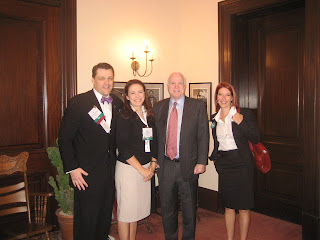
I have this completely dysfunctional relationship with Washington DC. As much as politics enfuriate and disgust me, I am completely drawn like a moth to the flame of the amazing power that this city and its inhabitants posess. My fascination of the history here is only thwarted by the fascination of the history being made here. As I return home to Arizona, I have had the opportunity to reflect upon the experiences of the week, process the overwhelming amount of political stimuli I was subjected to and focus my thoughts to the enormous battles we face as an industry trying to eradicate ourselves from the massive mistakes of the past.
The education packed week began with the Certified Mortgage Banker (CMB) Society Meeting and a tremendous presentation by HUD's Single Family Program Director, Meg Burns, who dispelled many of the journalistic myths about FHA. She began with the topic of FHA's financial health. As FHA has been pushed to the forefront in the financial crisis, with it's market share exploding from less than 5% to more than 30% of the business in the blink of an eye, it's mandated 2% capital requirement was not met. The press has blamed this on increased defaults and has spread fear of a threat to the insurance fund. The truth is that as FHA's portfolio has grown, so has the amount of the mandated capital reserve requirement. The reports of a significant increase of defaults has also not been accurately reflected in the press to account for the year over year increase in sheer volume. In fact, the credit quality of FHA's portfolio has significatly increased over prior years by almost a 50 points in average FICO scores. FHA has addressed the need to increase capital reserves by recently implementing an increase in the Up-Front FHA MIP from 1.75% to 2.25%. They are also supporting the FHA Reform Bill which would allow them to increase the annual (monthly) premium and reduce the up front premium.
I was also able to hear from several key members of Congress. Rep. James E. Clyburn (D-SC), who's role as the Majority Whip is to track the sentiment among party members for key legislation supported by the party's leader, spoke about understanding the difference between a bi-partisan bill and a bi-partisan vote. Both Rep. Paul Kanjorski (D-PA) and Senator Bob Corker (R-TN) spoke specifically to the topic of the massive regulatory reform bills being passed between the House and the Senate. Rep. Kanjorski, who chairs the House Sub-Committee on Capital Markets, Insurance and GSE's, spoke about the need to implement what has become known a as the Volcker Rule. This proposal was initiated by Economist and former Federal Reserve Chairman Paul Volcker to prohibit a bank or institutions that owns a bank from engaging in proprietary trading that isn't on behalf of its clients. It would also prohibit a bank from owning or investing in a hedge fund or private equity fund, as well as limits the liabilities that the largest banks could hold.
Senator Corker who sits on the Senate Banking Committee spoke of his experiences of working with Chariman Dodd to create a bi-partisan regulatory reform bill but was "left at the alter" so to speak, when the Democrats pulled the plug on bi-partisan work to consummate a bill that would quickly make it out of committee. “It is pretty unbelievable that after two years of hearings on arguably the biggest issue facing our panel in decades, the committee has passed a 1,300-page bill in a 21-minute, partisan markup. I don’t know how you can call that anything but dysfunctional,” were Senator Corker's sentiments. His main concerns for the senate bill fall into three areas, 1) lack of consumer protection, 2) poor underwriting in the past has only been addressed through risk retention rules that limits the leverage that the secondary market provides and 3) the fact that risk retention is a good soundbite but it will shut down liquidity in the market. The Senate bill is expected to be put to a floor vote as soon as the end of this month.
Finally, the Assistant Secretary for Financial Institutions for the US Treasury, Michael Barr commented on comprehensive financial reform. Currently, there are 7 different agencies that regulate the mortgage process, it is Mr. Barr's opinion that there needs to be a strong regulatory body to fill in the gaps of the fragmented oversight. He also feels that additional regulation is required of the financial markets to address the derivative market and contain swaps, an investment equivalent of the "Don't Come" line bet in craps. He thinks regulatory reform needs to also address the concept of "Too Big to Fail" with regulation in place to break down entities that can be sold off, if they are not compliant. This is something that would be paid for by fees assessed to the companies by the government.
Mr. Barr also proposes that lending institutions need "skin in the game" and explains that they must have risk retention to avoid making "risky" loans. None of this is to overshadow individual state regulation but add a federal standard "floor" that would allow states to regulate above and beyond.
It only took listening to Assistant Treasury Secretary Barr to get my passions riled enough to spend the entire next day raising awareness and the mortgage industry's concerns with 7 of the 10 Arizona political leaders in DC. In full campaign mode, John McCain wlecomed us with similar concerns over the far-sweeping Senate Regulatory Reform Bill as did the representatives from Jon Kyl's office. On the House side, revenue concerns were raised with the tax credit extension as well as an additional extension for the private mortgage insurance deduction which will sunset this year. Ending the day, we met with Rep. Jeff Flake, who is one of my personal favorites, to review the concerns with HR 4173, the reform bill that is so fully supported by the administration and the Treasury (at least Mr. Barr from the Treasury) and elicits tremendous concerns for me.
My anxiety is that of Risk Retention and the antecdotal message of "skin in the game." Ask any mortgage banker and they will tell you, we already hold skin in the game through buy-backs, reps and warrant requirements of lenders, FNMA/FHLMC and our warehouse lenders. Although this is presented as a risk control measure for risky underwriting decisions in the secondary market, it is blanketed to ALL mortgage lenders. New rules from the banking regulators and the SEC will require creditors to retain at least 5 percent of the credit risk associated with any loans that are transferred, sold or securitized. Thus a mortgage origination entity must capitalize 5% of their originations. In lay terms, if a locally owned mortgage company originated $1,000,000 in loans in a month, they must have $50,000 held aside. $10,000,000 a month would need $500,000 for risk retention. This is in addition to all the capital reserve, net worth and regulatory requirements already in place. Not only will that force most, if not all, independent mortgage lenders out of the business, it will create another liquidity crisis for the large depository lenders as there will be additional capital will be required. How do you think that capital will be raised? By increasing the required profit for each loan which translates into much higher costs to the consumer. Many see this as a massive move to eliminate competition by the big banks, but I feel that the banks will suffer as well. Just imagine your only option for a loan being Wells Fargo or Bank of America.
The other fear is the creation of one more entity created to monitor and regulate the mortgage industry. There are already 7 regulatory bodies who impact our business and the lack of communication and cooperation between them has already damaged our economy. The time, energy and cost that a new organization would generate does not fix the problem of the regulatory enforcement deficiencies that we have. As Rep. Marsha Blackburn expressed this morning on "Meet the Press", the Goldman Sachs lawsuit is a prime example of what went wrong in our country. What Goldman is accused of was a violation of CURRENT regulatory law of which is overseen by the SEC. We already have too many regulators not enforcing the already complicated patchwork of laws that we have, and the fix is to add another regulator?
I understand the concern of "Too Big to Fail." We certainly don't want to bail out any more corporate entities with taxpayer money, however, creating a reserve in which banks must pay fees to fund ultimately has the consumer paying that expenditure anyway through increased fees and costs passed along by the banks. I would agree to keep the requirement that says "Be a Bank or Be a Hedge Fund, it's your choice but you can't be both." Just don't try to fools us simple consumers that it won't cost us any money.
I will wrap up by repeating what I predicted in an article for AAR in February, the landscape of real estate finance in the future has not yet been finalized. The decisions that are made in Washington DC today and in the near future will determine how it will look. My commitment to being a voice for my industry, my customers and myself is once again solidified through my exasperation of the political process. I can't reiterate enough the importance of individual involvement. Don't let your future be determined by those like Michael Barr who wish say "I'm with the government and I am here to help."
I want to be the lender of choice for your customers so if I can be of assistance to you or your clients, please feel free to contact me at amy@amyswaney.com

Saturday, April 10, 2010
Sim Plify, Do You Have An Opinion on HVCC and Real Estate from A-Z
Sim Plify
You may have attended one of the many GFE/HUD-1 Classes that I have presented throughout the state and heard me talk about a cute and crafty sign in my sister’s house that says, “Sim plify” (SIM Pliffy). When asked about what that meant, she stated “Well, only I could expand (increase) “simplify””. I, of course, disagree. The government does a DARN GOOD job of it themselves.
In an additional effort to simplify the already confused topic of the new “Good Faith Estimate” HUD has once again expanded the guidance to lenders of how to comply with RESPA by releasing their April 2, 2010 revision to their FAQ’s making the grand total 62 pages…so far. Can you say, “Con Fusion?”The topic of Preapprovals and Preapproval Worksheets were one of the biggest changes. A warning for the faint of heart, the language used in the following paragraph many be confusing, perplexing, baffling and downright bewildering. Below is the additional guidance issued in the HUD FAQ’s.
"The following…address preapprovals. For the purposes of these questions, a preapproval is a document issued by a lender stating that a consumer qualifies for a specific loan amount. A preapproval is intended to assist a consumer who is shopping for a house by enabling the consumer to enter into a purchase contract that does not contain a financing contingency." (What???...Sorry, I digress)
"A preapproval is never to be used as a substitute for a GFE. If an applicant has chosen a property to purchase and the loan originator is willing to qualify the applicant for a specific loan amount, then a loan originator should issue the applicant a GFE that facilitates shopping for a loan, not just a preapproval used to shop for a property. For example, a lender may never issue only a preapproval to an applicant seeking to refinance his or her loan; the lender must also issue a GFE."
33) Q: Can a loan originator provide a GFE without a property address?
A: Yes, a loan originator can determine that a property address is not one of the required pieces of information that the loan originator needs in order to issue a GFE. It is important to note that a loan originator must consistently apply its policy on the information it deems necessary to issue a GFE, and the RESPA rule requires a loan originator to issue a GFE whenever it receives information sufficient to complete an application for a GFE. As a result, if a loan originator received an application for a preapproval and that application included all of the pieces of information that the loan originator requires to issue a GFE, the loan originator must issue a GFE and all of the rules that govern the GFE process would apply. In addition, if a GFE is issued without a property address, the future receipt of the property address is not a changed circumstance that would allow the loan originator to issue a revised GFE.
WAIT A MINUTE!!! So now doesn’t that directly contradict the previous FAQ’s numbers 4, 23 and 24?
4) Q: When does a loan originator have to issue a GFE?
A: A loan originator must issue a GFE no later than 3 business days after the loan originator receives an application or information sufficient to complete an application. Application is defined as the submission of a borrower‘s financial information in anticipation of a credit decision relating to a federally related mortgage loan, which shall include the following: (1) borrower‘s name, (2) borrower‘s monthly income; (3) borrower‘s social security number to obtain a credit report; (4) property address; (5) estimate of value of the property; (6) loan amount and (7) any other information deemed necessary by the loan originator.
23) Q: May a loan originator issue a GFE if the loan originator has not received one of the six pieces of information included in the definition of an application (borrower‘s name, borrower‘s monthly income, borrower‘s social security number, property address, estimate of the value of the property and mortgage loan amount sought)?
A: An application includes information the loan originator requires the borrower to submit in anticipation of a credit decision. If a loan originator issues a GFE, the loan originator is presumed to have received all six pieces of information.
24) Q: Are loan originators permitted to process a loan without all six pieces of information included in the definition of an application?
A: Yes. Loan originators may process a loan after they have issued a GFE and the borrower has received the GFE and has decided to proceed with the loan. It is presumed that, prior to issuing a GFE, a loan originator has received all six pieces of information.
So you are probably as clear on this additional guidance as lenders have been. You may, however, hear lenders say that they can issue GFEs now without a property address. Per HUD, this has to be the Lender’s standard of practice and the costs cannot change purely based upon an identified address. I would not expect lenders to jump on this bandwagon with such clear contradiction in guidance. You should still be wary if loan officers are
issuing LSRs stating that there has been a GFE issued without a contract in place.
Do You Think HVCC has Impacted the Real Estate Recovery?
Do you have an opinion about HVCC? Good or Bad? I want to know. I have been asked to sit on an Ad Hoc Committee to determine a position, for or against the continuation of HVCC. I want to hear from you, those who are in the trenches every day, as to whether you feel HVCC has personally impacted your business. I want to have real-life experiences to share with the committee to bring to light…or de-mystify…the here say of whether HVCC has brought quality up, helped or hurt the economics of real estate sales…or maybe there has been no impact at all. Please direct your comments to me at amy@amyswaney.com. This is your chance to say how you feel and have someone listen!
Don’t Miss Real “Estate from A-Z” on KFNN 1510 TOMORROW…SATURDAY, APRIL 10 at 9:00am with Bill Ashker and Roger Nelson
Want to hear the latest about HAMP, HAFA, RESPA, FHA and other lending topics? Please tune in to hear my interview with Bill and Roger. It should be informative, entertaining and a whole lot of fun! I promise…I won’t tell any of my jokes!
Ok, a blonde walks into a building and goes up to a lady and says "Can I have a cheeseburger, fries and a shake?"
The lady looks at her dumbfounded and says
"Miss, this is a library."
So the blonde moves closer and whispers,
"Can I have a cheeseburger, fries and a shake?"
I want to be the lender of choice for your customers so if I can be of assistance to you or your clients, please feel free to contact me at amy@amyswaney.com.
You may have attended one of the many GFE/HUD-1 Classes that I have presented throughout the state and heard me talk about a cute and crafty sign in my sister’s house that says, “Sim plify” (SIM Pliffy). When asked about what that meant, she stated “Well, only I could expand (increase) “simplify””. I, of course, disagree. The government does a DARN GOOD job of it themselves.
In an additional effort to simplify the already confused topic of the new “Good Faith Estimate” HUD has once again expanded the guidance to lenders of how to comply with RESPA by releasing their April 2, 2010 revision to their FAQ’s making the grand total 62 pages…so far. Can you say, “Con Fusion?”The topic of Preapprovals and Preapproval Worksheets were one of the biggest changes. A warning for the faint of heart, the language used in the following paragraph many be confusing, perplexing, baffling and downright bewildering. Below is the additional guidance issued in the HUD FAQ’s.
"The following…address preapprovals. For the purposes of these questions, a preapproval is a document issued by a lender stating that a consumer qualifies for a specific loan amount. A preapproval is intended to assist a consumer who is shopping for a house by enabling the consumer to enter into a purchase contract that does not contain a financing contingency." (What???...Sorry, I digress)
"A preapproval is never to be used as a substitute for a GFE. If an applicant has chosen a property to purchase and the loan originator is willing to qualify the applicant for a specific loan amount, then a loan originator should issue the applicant a GFE that facilitates shopping for a loan, not just a preapproval used to shop for a property. For example, a lender may never issue only a preapproval to an applicant seeking to refinance his or her loan; the lender must also issue a GFE."
33) Q: Can a loan originator provide a GFE without a property address?
A: Yes, a loan originator can determine that a property address is not one of the required pieces of information that the loan originator needs in order to issue a GFE. It is important to note that a loan originator must consistently apply its policy on the information it deems necessary to issue a GFE, and the RESPA rule requires a loan originator to issue a GFE whenever it receives information sufficient to complete an application for a GFE. As a result, if a loan originator received an application for a preapproval and that application included all of the pieces of information that the loan originator requires to issue a GFE, the loan originator must issue a GFE and all of the rules that govern the GFE process would apply. In addition, if a GFE is issued without a property address, the future receipt of the property address is not a changed circumstance that would allow the loan originator to issue a revised GFE.
WAIT A MINUTE!!! So now doesn’t that directly contradict the previous FAQ’s numbers 4, 23 and 24?
4) Q: When does a loan originator have to issue a GFE?
A: A loan originator must issue a GFE no later than 3 business days after the loan originator receives an application or information sufficient to complete an application. Application is defined as the submission of a borrower‘s financial information in anticipation of a credit decision relating to a federally related mortgage loan, which shall include the following: (1) borrower‘s name, (2) borrower‘s monthly income; (3) borrower‘s social security number to obtain a credit report; (4) property address; (5) estimate of value of the property; (6) loan amount and (7) any other information deemed necessary by the loan originator.
23) Q: May a loan originator issue a GFE if the loan originator has not received one of the six pieces of information included in the definition of an application (borrower‘s name, borrower‘s monthly income, borrower‘s social security number, property address, estimate of the value of the property and mortgage loan amount sought)?
A: An application includes information the loan originator requires the borrower to submit in anticipation of a credit decision. If a loan originator issues a GFE, the loan originator is presumed to have received all six pieces of information.
24) Q: Are loan originators permitted to process a loan without all six pieces of information included in the definition of an application?
A: Yes. Loan originators may process a loan after they have issued a GFE and the borrower has received the GFE and has decided to proceed with the loan. It is presumed that, prior to issuing a GFE, a loan originator has received all six pieces of information.
So you are probably as clear on this additional guidance as lenders have been. You may, however, hear lenders say that they can issue GFEs now without a property address. Per HUD, this has to be the Lender’s standard of practice and the costs cannot change purely based upon an identified address. I would not expect lenders to jump on this bandwagon with such clear contradiction in guidance. You should still be wary if loan officers are
issuing LSRs stating that there has been a GFE issued without a contract in place.
Do You Think HVCC has Impacted the Real Estate Recovery?
Do you have an opinion about HVCC? Good or Bad? I want to know. I have been asked to sit on an Ad Hoc Committee to determine a position, for or against the continuation of HVCC. I want to hear from you, those who are in the trenches every day, as to whether you feel HVCC has personally impacted your business. I want to have real-life experiences to share with the committee to bring to light…or de-mystify…the here say of whether HVCC has brought quality up, helped or hurt the economics of real estate sales…or maybe there has been no impact at all. Please direct your comments to me at amy@amyswaney.com. This is your chance to say how you feel and have someone listen!
Don’t Miss Real “Estate from A-Z” on KFNN 1510 TOMORROW…SATURDAY, APRIL 10 at 9:00am with Bill Ashker and Roger Nelson
Want to hear the latest about HAMP, HAFA, RESPA, FHA and other lending topics? Please tune in to hear my interview with Bill and Roger. It should be informative, entertaining and a whole lot of fun! I promise…I won’t tell any of my jokes!
Ok, a blonde walks into a building and goes up to a lady and says "Can I have a cheeseburger, fries and a shake?"
The lady looks at her dumbfounded and says
"Miss, this is a library."
So the blonde moves closer and whispers,
"Can I have a cheeseburger, fries and a shake?"
I want to be the lender of choice for your customers so if I can be of assistance to you or your clients, please feel free to contact me at amy@amyswaney.com.
Subscribe to:
Posts (Atom)

 Posts
Posts


